



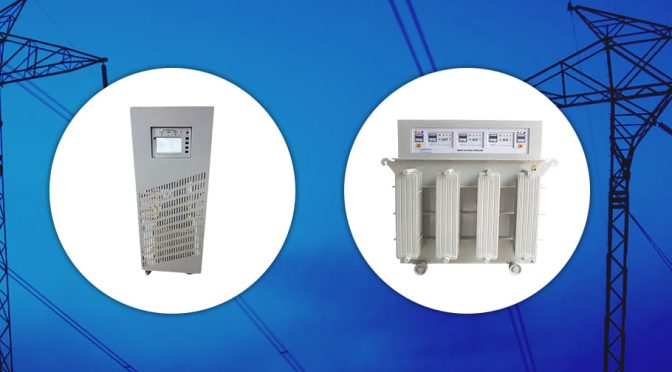
When dealing with the issue of safety of electrical equipment against the changes of voltage, it is necessary to select the correct stabilizer. Two of them are CVT (Constant Voltage Transformer) and Servo Stabilizers that have become popular. Though both of them are used to regulate the voltage, they operate quite differently and are applied to various circumstances.
In the present guide by Servo Star, the distinction between CVT and servo stabilizers will be divided in a simple and practical manner. This will assist you in making the correct decision in respect to your business or home.
Understanding Voltage Fluctuations
The problem of voltages fluctuation is common in most locations. It may cause destruction of delicate machines. It is also able to lessen the life of machines. As such, a stabilizer is required.
There is however no uniform stabilizer. At this stage, CVT and servo stabilizers are involved.
What is a CVT Stabilizer?
A CVT (Constant Voltage Transformer) is developed to give a fixed output voltage. It is a voltage controller that operates on magnetic principles.
It is plain in construction. It does not have any moving components. Consequently, it does not need much maintenance.
Key Features of CVT:
- Offers a continuous voltage output.
- Works that do not have electronic circuits.
- Very dependable when using small loads.
- Low maintenance
CVTs have a low capacity, however. They find their application mostly in low-power applications.
What is a Servo Stabilizer?
A more complicated device is a Servo Stabilizer. It employs a motor that is made of a servo control of the variation of voltage.
It maintains a constant check on input voltage. It then controls the production through a motor-operated system. This is so as to provide exact voltage correction.
Key Features of Servo Stabilizer:
- High accuracy in voltage correction
- Suitable for heavy and industrial loads
- Works for wide voltage ranges
- Offers better efficiency
Due to the characteristics, servo stabilizers are extensively applied in industries.
Key Differences Between CVT and Servo Stabilizer
At this point, we will pick up the essence of the distinctions between these two systems.
1. Working Principle
- CVT is based on magnetic saturation.
- Servo Stabilizer operates on motor driven voltage correction.
Consequently, servo stabilizers are livelier and reactive.
2. Accuracy
- CVT is moderate in its accuracy.
- Servo Stabilizer is of high precision output voltage.
Thus, sensitive equipment is better servo stabilized.
3. Load Capacity
- CVT is appropriate with small loads.
- Servo Stabilizer is used with small and large loads.
This renders servo stabilizers suitable in the industrial usage.
4. Response Time
- CVT has a fixed response.
- Servo Stabilizer adjusts continuously.
Hence, servo stabilizers react better to sudden voltage changes.
5. Maintenance
- CVT requires minimal maintenance.
- Servo Stabilizer needs periodic servicing due to moving parts.
Even then, servo stabilizers offer better performance overall.
6. Cost Factor
- CVT is usually more affordable.
- Servo Stabilizer is higher in cost but offers better value.
In the long run, servo stabilizers prove more beneficial.
Where Should You Use a CVT?
CVTs are best suited for:
- Small office equipment
- Computers and low-power devices
- Areas with minor voltage fluctuations
If your requirement is basic, CVT can be a good option.
Where Should You Use a Servo Stabilizer?
Servo stabilizers are ideal for:
- Industrial machinery
- Medical equipment
- Printing machines
- CNC machines
- Air conditioners and heavy appliances
In short, if your equipment is expensive or sensitive, a servo stabilizer is the safer choice.
Why Servo Stabilizers Are More Popular Today
In modern applications, power requirements are higher. Equipment is more sensitive. Therefore, precision matters more than ever.
Servo stabilizers offer:
- Better control
- Higher efficiency
- Long-term protection
Because of this, industries prefer servo stabilizers over CVTs.
Choosing the Right Stabilizer for Your Needs
Before selecting a stabilizer, consider the following:
- Load requirement
- Voltage fluctuation level
- Type of equipment
- Budget
If your setup is small and simple, CVT may work. However, for advanced needs, servo stabilizer is the better investment.
Final Thoughts
There are the advantages of both CVT and servo stabilizer. They are however used differently.
CVT is non-complicated and low cost. Servo stabilizer on the other hand is strong and accurate.
In the case of Servo Star, we would suggest that a stabilizer should be selected depending on your real need. A servo stabilizer is the best option in case you require reliability, accuracy and long performance.
FAQs
1. Which is better, CVT or servo stabilizer?
Servo stabilizers are generally better due to higher accuracy and load capacity.
2. Is CVT good for home use?
Yes, CVT can be used for small home appliances and electronics.
3. Why are servo stabilizers used in industries?
Because they handle heavy loads and provide precise voltage control.
4. Does a servo stabilizer consume more power?
It consumes slightly more power but offers better protection and efficiency.


